Quality Testing and Certificates Explained
Every supplier will send you a certificate. Fewer can explain what is on it, and
that is the useful question — a report you cannot read is not a quality control.
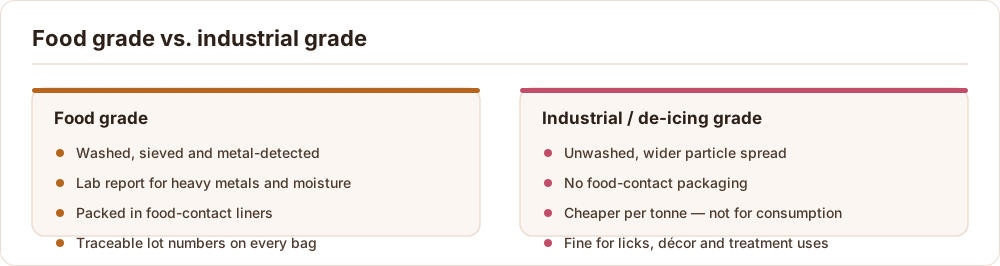
*Figure 1 — The same seam can yield both. Processing and documentation are what
separate them.*
What a lab report should contain
| Test | Typical result | Why it matters |
|---|---|---|
| NaCl assay | 97–99% dry basis | The core purity measure |
| Moisture | ≤ 0.5% | Caking and shipping weight |
| Water-insoluble matter | ≤ 0.5% | Clay and dust carried from the mine |
| Sieve analysis | ≥ 90% in range | Whether the granulation matches your spec |
| Heavy metals | Below destination limits | Lead, arsenic, cadmium, mercury |
| Bulk density | 1.1–1.3 g/cm³ | Filling line and packaging calculations |
Two details separate a real report from a decorative one:
- It names a lot number that matches your consignment.
- It is dated within a sensible window of your shipment.
A generic report with no lot reference tells you what the supplier's salt looked
like once, not what is in your container.
Certificates that matter for import
- Certificate of Analysis (COA) — the lab report above, per lot.
- Certificate of Origin — required for customs and preferential duty.
- Health / free-sale certificate — required by some markets for food goods.
- ISPM 15 fumigation stamp — for wooden pallets.
- HACCP or ISO 22000 (facility level) — evidence of a managed food-safety
system, not a per-lot document.
- Halal / Kosher — where your market requires it; ask which certifier.
Testing on arrival
Even with a good COA, run your own checks on a first order:
- Sieve a sample against your spec.
- Measure moisture, or send a sample to a local lab.
- Dissolve a portion and look for sediment.
- Retain a sealed sample from every lot, labelled with the lot number.
That retained sample is the cheapest insurance you can buy. When a customer
complains eighteen months later, it is the only way to tell whether the problem
came from the salt or from the storage.
Reading between the lines
Watch for:
- Reports with no accreditation mark or laboratory address
- Heavy metals shown as "not detected" with no detection limit stated
- Sieve results with no tolerance percentage
- A COA dated before the production run it supposedly covers
None of these prove bad faith, but each is worth a question. A supplier who
answers them clearly is one you can build a second order on — which is what
choosing a supplier is really about.
Asian Salts issues a per-lot COA from an accredited laboratory with every
shipment, and holds retained samples at origin. Ask for a current sample report
with your quote.