What Makes Himalayan Pink Salt Different
Himalayan pink salt is rock salt from the Salt Range in northern Pakistan — a seam
laid down when an ancient sea evaporated roughly 250 million years ago, then
folded upward as the subcontinent collided with Asia. The Khewra mine, where
most of it is cut, has been worked continuously since the Mughal era.
Why it is pink
The colour comes from trace iron oxide locked into the crystal lattice. The more
iron, the deeper the blush — which is why a single mine face yields everything
from near-white crystal to deep orange-red. Colour is a sorting grade, not a
quality grade: a pale crystal and a dark one from the same seam are chemically
almost identical.
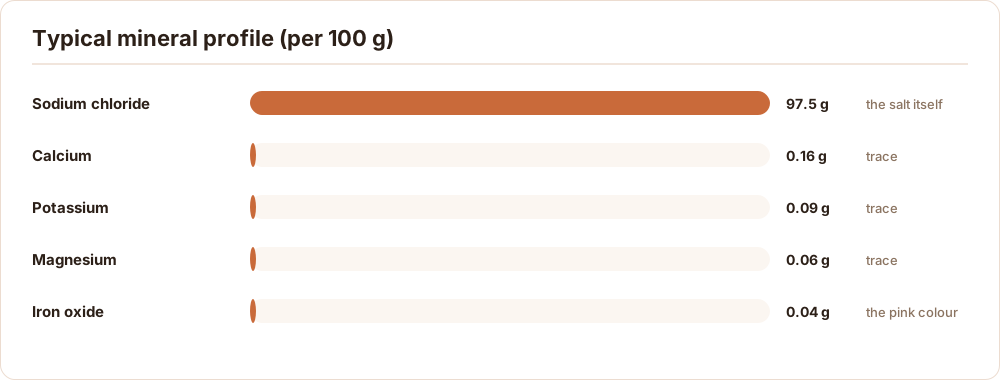
*Figure 1 — Around 97–98% sodium chloride; everything that gives the salt its
character sits in the remaining couple of percent.*
How it compares
| Refined table salt | Sea salt | Himalayan pink salt | |
|---|---|---|---|
| Source | Mined, then chemically refined | Evaporated seawater | Mined rock salt |
| Processing | Heavily refined, anti-caking agents | Lightly processed | Crushed, washed, graded |
| Trace minerals | Stripped | Variable, includes modern marine content | Sealed underground for millennia |
| Typical use | Everyday cooking | Finishing | Table, finishing, lamps, blocks, spa |
The practical difference most cooks notice is not chemistry but crystal shape.
A coarse pink crystal dissolves more slowly and lands on the tongue as a distinct
burst, which is why it finishes a dish so well. A fine grind behaves much like any
other fine salt in a recipe.
Buy pink salt for its purity, its crystal structure and its versatility across
product categories — not for a mineral supplement claim it cannot support.
More than a seasoning
The reason this one raw material supports an entire product range is that the
crystal is large, structurally sound and beautifully translucent:
- Edible grades — fine, medium and coarse for the table and kitchen.
- Lamps and décor — hand-carved from large lumps.
- Cooking blocks and tiles — sawn slabs that hold heat for searing.
- Bath and spa — coarse granules that dissolve slowly in warm water.
- Animal licks — pressed or natural blocks for livestock.
What to check when you buy
- Origin documentation — the Salt Range, with a mine or lot reference.
- A recent lab report — heavy metals, moisture, and NaCl percentage.
- Consistent granulation — sieve-tested, not eyeballed.
- Food-contact packaging for anything edible.
Asian Salts mines, processes and packs at source, so every consignment traces
back to a specific lot. If you are comparing suppliers, ask for all four of the
above in writing — the answers tell you more than a price list will.