Himalayan Salt Grades and Granulation Explained
"Coarse" means different things to different suppliers, which is how buyers end
up with a container of salt that will not fit their grinder. Granulation should
always be ordered as a millimetre range, not an adjective.
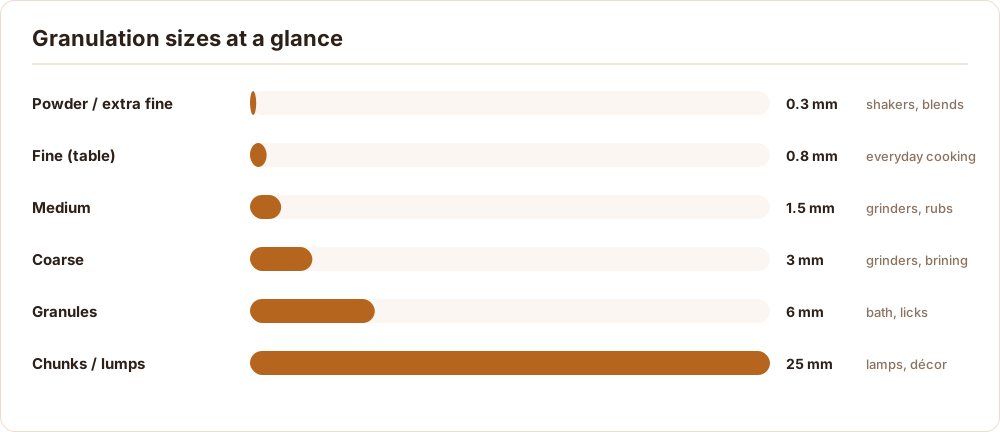
Figure 1 — Nominal particle sizes across the standard grades.
The standard grades
- Powder / extra fine (0.1–0.5 mm) — shaker salt, seasoning blends, cosmetics.
- Fine (0.5–1.0 mm) — the everyday table and cooking grade.
- Medium (1.0–2.0 mm) — refillable grinders and dry rubs.
- Coarse (2.0–4.0 mm) — grinders, brining, salt crusts.
- Granules (4.0–8.0 mm) — bath soaks, salt licks, decorative fills.
- Chunks and lumps (25 mm+) — lamps, cooking blocks, carved pieces.
How a spec should read
A complete granulation spec has four parts:
- Range — e.g. 2.0–4.0 mm.
- Tolerance — e.g. minimum 90% within range on a sieve test.
- Fines limit — e.g. maximum 3% passing 1.0 mm.
- Moisture — typically ≤ 0.5% for packed edible grades.
That last one matters more than buyers expect. Salt that ships slightly damp will
cake in transit, and a caked bag of "free-flowing fine" is a rejected delivery.
Matching grade to product
| Product | Grade | Note |
|---|---|---|
| Table shaker | Fine | Add an anti-caking agent only if your market allows it |
| Refill grinder | Medium or coarse | Test with your actual grinder mechanism |
| Brining and curing | Coarse | Dissolves at a controlled rate |
| Bath soak | Granules | Slow dissolve, visible crystal |
| Salt lamp | Chunk | Sorted for colour and shape |
| Cooking block | Sawn slab | Cut from selected defect-free lumps |
Colour grades
Alongside size, edible and decorative salt is sorted by colour — commonly light
pink, standard pink and dark pink/red. For lamps this is the dominant price
driver; for edible salt it is largely cosmetic. Specify it if your packaging
shows the product through a window, and ignore it if it does not.
Send us the grade, tolerance and monthly volume you need and we will confirm
what we can hold in continuous production — including whether a custom sieve cut
is worth the extra processing cost for your order size.